A dental implant is made up of three parts: the implant itself, a small titanium screw placed in the jawbone to replace the root; the abutment, a connecting piece that passes through the gum; and the crown, the visible "tooth", made of ceramic. Together, they replace a whole tooth, from the root right up to the part you chew with.
Knowing what each part does makes it easier to follow your treatment and to read a quote. Here is how they fit together, what they are made of and how to make them last. For the full procedure, costs and reimbursement, see our page on dental implants in Luxembourg-Bonnevoie.
🦷 The three parts of a dental implant
A natural tooth has two parts: the root, anchored in the bone, and the crown, visible in the mouth. An implant recreates this structure with three parts that are made separately and then assembled over the course of treatment.
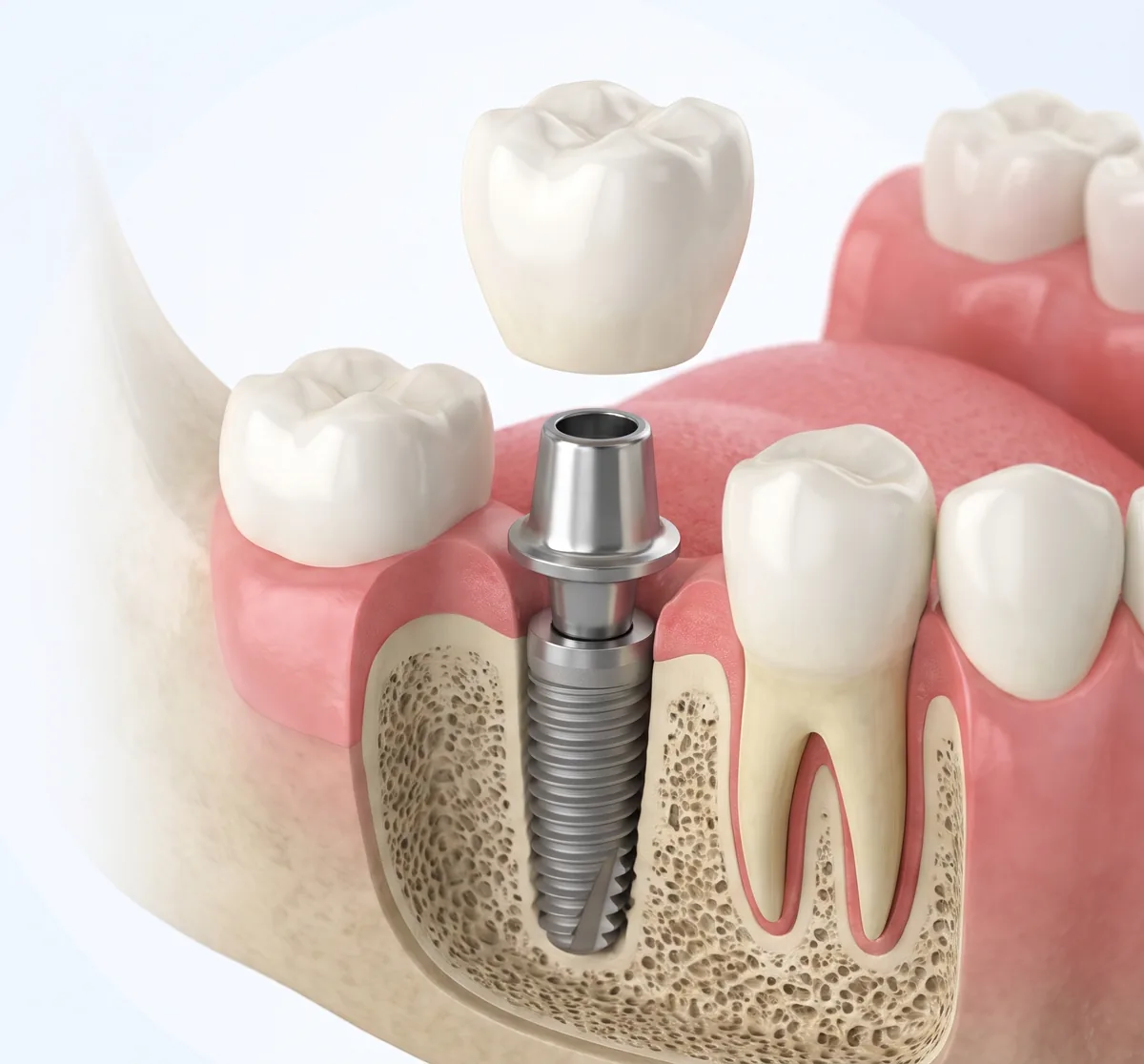
Illustration: the implant in the bone, the abutment rising above the gum and the crown ready to be fitted.
🔩 1. The implant: the artificial root
This is the part often called "the screw". It is a small threaded cylinder, a few millimetres wide and about a centimetre long, placed in the jawbone where the tooth is missing. Its surface is treated so that the bone attaches to it.
Once in place, the implant can no longer be seen: it stays under the gum throughout healing. Its length and width are chosen according to the available bone, measured before the procedure with a 3D scan (CBCT) taken right here at the practice.
🔗 2. The abutment: the connecting piece
The abutment is screwed into the implant. It passes through the gum and supports the crown. It can be a standard part or custom-made to follow the shape of the gum as closely as possible.
During healing, a healing cap is often fitted in its place: it helps the gum take shape around the implant. The final abutment is then placed when impressions are taken or when the crown is fitted.
👑 3. The crown: the visible part
The crown is the only part you see when you smile. Custom-made, usually from ceramic, it matches the shape and shade of your neighbouring teeth. It is attached to the abutment, either screwed or cemented (see below).
When several teeth are missing, you don't always need one implant per tooth: an implant-supported bridge can rest on two implants, and a full arch can be fixed on four or more implants, depending on the case.
🧪 What is a dental implant made of?
Each part has its own material, chosen for its strength and for how well the body tolerates it.
| Part | Common materials | Why this choice |
|---|---|---|
| Implant | Titanium or titanium alloy; more rarely zirconia | Very well tolerated, it bonds firmly to the bone |
| Abutment | Titanium or zirconia | Strong; white zirconia is sometimes preferred for front teeth |
| Crown | Ceramic (zirconia or aesthetic ceramic), sometimes porcelain fused to metal | Strong and close to the look of a natural tooth |
⚙️ Titanium or zirconia?
Titanium is the reference material: used for several decades, it is very well tolerated and the way it bonds with bone is extensively documented. Titanium allergies are very rare.
There are also zirconia implants, made of a white ceramic, which some patients ask for because they want to avoid metal. They have a shorter clinical track record and more limited indications. The choice of material is discussed at your assessment, based on your situation.
🔧 Screw-retained or cemented crown: what's the difference?
The crown can be attached to the abutment in two ways:
- Screw-retained: a screw passes through the crown to fix it to the implant. The small access hole is then sealed with a tooth-coloured material. The advantage: the crown can be removed if a check-up or repair is needed.
- Cemented: the crown is bonded to the abutment with dental cement, like a conventional crown. No hole is visible, which can be an advantage for some front teeth.
Your dentist chooses the option best suited to the position of the tooth, the space available and the look you want.
🩻 How the implant holds in the bone: osseointegration
After placement, the bone rebuilds around the implant and bonds firmly to it: this is called osseointegration. It takes 3 to 6 months on average. In the meantime, a temporary tooth can be fitted so that you are not left with a visible gap.
Several factors help the implant integrate well: enough bone volume, healthy gums, little or no smoking and, where relevant, well-controlled diabetes. If there is not enough bone, a bone graft can rebuild the volume needed before or during placement.
🗓️ In what order are the parts fitted?
- Assessment and 3D scan: examination of the mouth and gums, a CBCT scan to measure the bone, then a treatment plan and a detailed quote.
- Placing the implant: under local anaesthetic, 30 to 60 minutes per implant. Mild discomfort may last 2 to 3 days.
- Healing: 3 to 6 months on average, with a temporary tooth if needed.
- Abutment and final crown: impressions are taken, then the abutment and the ceramic crown are fitted, screw-retained or cemented.
💶 How much does an implant cost and what does the CNS cover?
As a guide, an implant with its crown usually costs between €1,500 and €2,500 in Luxembourg. The price depends on the number of implants, whether a bone graft is needed and the type of crown. You receive a detailed quote at your assessment, with no obligation.
The implant itself is not reimbursed by the CNS. The crown placed on the implant may be partly covered, subject to prior approval: we show this on your quote. Supplementary insurance may cover part of the rest. You will find all the details in our FAQ on dental reimbursement in Luxembourg.
🪥 How to make your implant last
A well-integrated implant is designed to last for many years. It cannot decay, but the gum and bone around it remain sensitive to dental plaque: without good hygiene, inflammation can develop around the implant (peri-implantitis), similar to gum disease around a natural tooth.
- Brush your teeth twice a day, paying particular attention to where the crown meets the gum.
- Clean between your teeth every day, with interdental brushes or floss.
- Come for regular check-ups: your dentist checks the gum, the bone and the tightness of the parts, and carries out a professional clean.
- Cut down on smoking, which weakens the gum and bone around the implant.
❓ Frequently asked questions about dental implant parts
🔩 Is a dental implant a screw?
Not quite. The implant is indeed shaped like a screw: it is the artificial root, placed in the bone. But it only replaces the tooth once the abutment and crown have been added. When people talk about a "screw-in tooth", they actually mean all three parts together.
🔗 What is an abutment?
It is the intermediate piece screwed into the implant. It passes through the gum and supports the crown. It is usually made of titanium or zirconia.
🧲 Can you be allergic to titanium?
It is very rare. If you have reacted to metals before, mention it at your assessment: your dentist will take it into account when choosing the materials.
👀 Can you see a dental implant?
No. The implant stays in the bone, under the gum. Only the crown is visible, and it is custom-made to blend in with your teeth. For front teeth, a zirconia abutment may be chosen to avoid any greyish shadow showing through thin gum.
⏳ How long does a dental implant last?
A well-integrated implant is designed to last for many years. How long it lasts depends mainly on your daily hygiene, regular check-ups and your general health, especially smoking. The crown, on the other hand, can wear over time and can usually be replaced without touching the implant.
📞 Planning an implant? Assessment with a 3D scan in Bonnevoie
Your dentist examines your mouth and gums, takes a 3D scan if needed, then explains the treatment plan and gives you a detailed quote, with no obligation. Dentalplus welcomes you 7 days a week in Luxembourg-Bonnevoie.
Book an appointment online or call us on (+352) 27 52 18 25.